
Paipe is a company focused on business and information technology solutions. It excels in service delivery and offers a portfolio of innovative solutions as its main deliverable, combining the needs and business requirements of its clients.
It has a team of highly qualified collaborators and partner companies to design the best solutions. Thus, it develops business platform projects, mobile solutions, and other applications that utilize the most modern technologies on the market.
Many clients seek out Paipe in search of solutions to existing problems. One of them presented a preliminary project idea involving data intelligence, artificial intelligence, and mathematical modeling.
The initial contact with this company was made by Marcelo Dannus, CEO of Paipe, along with partners Rogério Nath, CEO of 4Show, and Professor Rodrigo Dalla Vecchia. The project scope was discussed and agreed upon in the initial stages, with a clear discussion of the needs, objectives, and expected results, mapping the entire process, opportunities, and the client's desires, with focus on the main problem.
The customer
This is a company with over 12 years of history that delivers M2M/IoT connectivity solutions throughout Brazil. It helps its clients achieve maximum communication potential between devices, serving diverse applications across various sectors. Its purpose is to deliver the best Telecom experience for the Internet of Things (IoT) market.
One of their solutions is to ensure connectivity in fleet vehicle tracking for large logistics companies, which monitor and track trips in real time.
The challenge
The challenge was to efficiently identify potential anomalies in transmission towers (antennas). When cargo vehicles go offline due to lack of mobile data, they become vulnerable to theft and loss. Therefore, keeping SIM cards operational is vital for delivery companies.
Any problems that had previously occurred due to lack of connectivity were reported by the customers themselves. But with more than 280,000 antennas, this process became humanly impossible. The project's objective was precisely to reverse this logic: to start predicting possible failures in the company's networks, so that it could inform customers in advance about the measures to be taken. This was exactly what the customer was looking for when contacting Paipe.
The solution
Based on this, Paipe, in co-creation with the client, generated a feedback model from the company's internal team, allowing the sharing of information and knowledge between both parties. The project applies AI (artificial intelligence) with mathematical algorithms and machine learning concepts to the... identification of anomalies in transmission towers Signal to SIM cards, in real time.
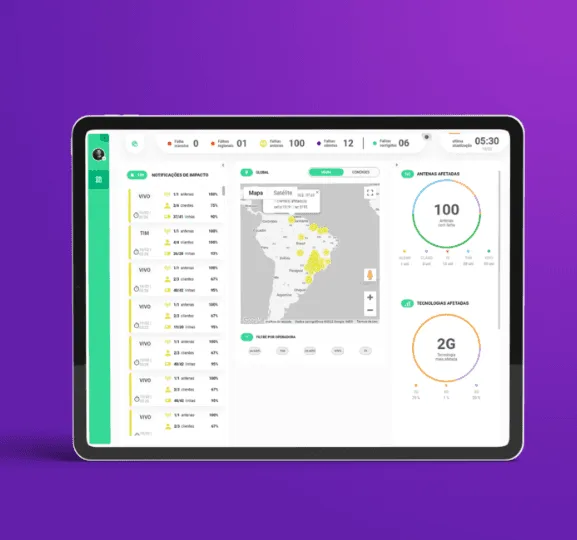
The AI algorithm, linked to a dashboard, spends all day diagnosing the client company's network, learning from each incident and providing advance warnings of potential failures.
Minute-by-minute diagnosis
“"Today, with the technology we've built, they know minute by minute what's going wrong, and they can already talk to customers, assist them, inform them that there's a problem, and that they're taking all possible actions to resolve it." — Rodrigo Dalla Vecchia.
For the algorithm to be able to perform this quick reading, statistical techniques are used, along with machine learning and AI techniques, which help in making safe decisions.
A lightweight algorithm, in seconds instead of minutes.
One of the biggest challenges of the project was creating a lightweight algorithm capable of delivering this data minute by minute. Currently, it takes 20 to 30 seconds to run, compared to around two minutes previously—making the process much faster.
What the dashboard shows
Among the information displayed on the platform's dashboard are:
- Map showing the location of the faults;
- Affected customers;
- the impact generated;
- Which operators are available?;
- number of antennas;
- If the problem lies with the customer, and not with any antenna.
Value proposition
The solution improves the level of service delivered to the end customer. Furthermore, the speed of analysis represents a strong capacity to handle large volumes of data—generating significant insights from that data.
For businesses, data is invaluable; but nowadays, it's the analysis of that data that truly generates value.
Why anomaly detection with AI matters
Cases like this illustrate a principle that applies far beyond IoT networks: detecting anomalies with AI allows action to be taken before the problem becomes visible to the end customer.
From reaction to anticipation
Instead of discovering flaws through complaints, the company identifies abnormal patterns in the data and acts preventively. The impact on customer experience is direct: each flaw predicted in time means a customer who doesn't become frustrated.
Predictive maintenance
In communication networks, fleets, industrial equipment, or critical infrastructure, predicting failures reduces downtime costs, prevents losses, and increases reliability—all based on the data that the operation already generates.
AI, IoT, and real-time data: a powerful combination.
The IoT generates enormous volumes of data; AI is what transforms that volume into decisions. Together, they create the foundation for smarter and more proactive services.
The role of real-time data
In sensitive operations, such as fleet tracking, losing mobile data means losing visibility — and security. That's why real-time data, combined with algorithms capable of interpreting it quickly, are so strategic.
Lightweight algorithms, fast decisions.
Having a powerful model isn't enough; it needs to run efficiently. Investing in lean algorithms capable of delivering answers in seconds allows the operation to react while the problem is still small.
Lessons from the project for other operations.
More than an isolated case, this project offers lessons applicable to other realities:
- Start with the concrete problem, not the available technology;
- Co-create with the client, leveraging their business knowledge;
- Prioritize real-time data when operations depend on it;
- Treat performance as a requirement — fast algorithms, not just accurate ones;
- Use AI to support the team, not to replace customer contact.
These principles often separate AI projects that remain experimental from those that deliver real impact.
Where else can this type of solution be applied?
The combination of AI, real-time data, and anomaly detection adapts to very different contexts:
- telecommunications and network infrastructure;
- industry, with monitoring of machines and production lines;
- Logistics and fleet management, including route and equipment monitoring;
- energy, preventing failures in distribution networks;
- Retail and e-commerce, detecting anomalies in transactions and inventory.
The guiding principle is the same: read the data continuously and act on the signals before they become a problem.
Frequently Asked Questions
What is M2M and how does it relate to IoT?
M2M (machine to machine) is direct communication between machines via networks — and is one of the pillars of the Internet of Things (IoT), which connects devices so they can exchange data and generate useful information.
How does AI identify anomalies in a network?
Algorithms continuously analyze the data generated by the operation and learn what constitutes "normal behavior." When something deviates from this pattern, the system signals the anomaly, allowing action to be taken before it becomes an incident.
Why are lightweight algorithms so important?
Because, in real-time decision-making, speed matters as much as accuracy. An efficient model, capable of running in seconds, makes the difference between preventing the problem or simply explaining it afterward.
Is this type of solution suitable for other sectors?
Yes. The same principle (collecting data, detecting anomalies, and anticipating failures) applies to fleets, industry, energy, retail, and any operation that depends on a large volume of real-time data.
Conclusion
With excellence in delivery and a constant search for the best solution for its clients, Paipe's success is based on innovation. This is why many companies seek out Paipe for improvements and the development of new projects and products.
This case study demonstrates how the combination of AI, IoT, and real-time analytics can transform customer relationships—shifting from reaction to anticipation. Ultimately, this is what differentiates data-driven operations: the ability to act before a problem arises.